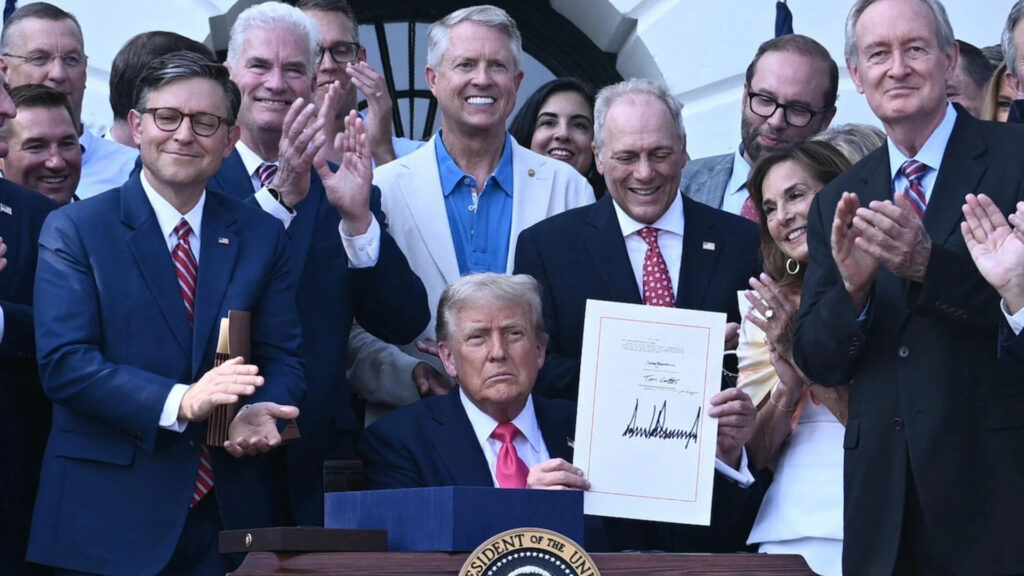
Trump signed the OBBB Act on July 4, 2025 with GOP members of Congress (all of
whom gleefully stand to make THOUSANDS in extra tax breaks for themselves on the
backs of the working poor and elderly).
The 2028 sunset on the senior tax break just makes the whole thing even more cynical, so it slots neatly into the same argument with one more ugly data point.
One Big Beautiful Bill: The “Beautiful” Burden (And Who Actually Pays For It)
Let’s cut the spin: The OBBB Act, written, marketed, and signed with maximum fanfare, is a branding exercise wrapped around a redistribution plan that tilts hard toward the top half of the income ladder while handing the bottom rungs a handful of loose change and a notice of eviction. Independent distributional analyses show the bottom 10% of households taking a meaningful income hit over the coming decade, while the top brackets walk away with net gains once tax cuts and program cuts are added up. The sales pitch is “working‑class tax relief”; the balance sheet reads like a love letter to higher earners.
Medicaid, Medicare, And The “Fraud And Waste” Fairy Tale
The claim that Medicaid wasn’t “cut” except for “waste, fraud, and abuse” collapses the moment you look at the actual mechanics. The Act tightens the screws on Medicaid’s financing by reducing the provider tax safe harbor and capping state‑directed payments at or near Medicare rates, which directly limits how much states can draw down in federal matching funds. It also layers in work and “community engagement” requirements that function less as anti‑fraud measures and more as paperwork tripwires, predictably knocking low‑income adults off the rolls without changing their underlying need for care. Medicare, for its part, gets a mix of cost controls and payment adjustments that may not be labeled “cuts” but still shift risk and cost pressure back toward beneficiaries over time.
Tips, Overtime, And The Working‑Class Sweetener
To give the talking points something shiny, the law does make federal income on tips and overtime a lot less painful. Provisions exempting tips and overtime premiums from federal income tax do meaningfully raise take‑home pay for many service and hourly workers, who can see hundreds or even low thousands of extra dollars a year depending on hours and earnings. But those gains sit on top of a floor that is being quietly dug out from underneath them through Medicaid retrenchment and other benefit reductions, so the net for the lowest‑income households is still negative once you add everything up.
Seniors’ “Biggest Ever” Tax Break…With An Expiration Date
Then there is the senior deduction, which was rolled out with great fanfare as proof that the bill showers love on retirees. The OBBB creates an additional 6,0006{,}0006,000 deduction for taxpayers 65 and older, per person, starting in 2025—12,00012{,}00012,000 for a married couple where both qualify—on top of the existing extra standard deduction for seniors. That sounds generous, until you read the fine print: the statute explicitly confines this new benefit to tax years 2025 through 2028, at which point the extra senior deduction vanishes unless a future Congress revives it. In other words, the “historic” senior tax break is a four‑year promotional teaser, not a structural shift; retirees get a temporary boost that conveniently fits inside the ten‑year budget window while the permanent corporate and upper‑income provisions keep on running.
Claims Versus Text: Side‑By‑Side
| Political claim | What the OBBB actually does |
|---|---|
| “We didn’t cut Medicaid or Medicare, just targeted fraud and waste with work requirements.” | The Act limits state Medicaid financing tools (provider tax safe harbor cuts, caps on state‑directed payments) and adds work/community‑engagement rules that predictably reduce enrollment, lowering real‑world coverage and spending for low‑income adults. Medicare faces cost and payment changes that shift pressure back onto beneficiaries even if they’re not labeled outright “cuts.”a |
| “We helped working‑class Americans most by eliminating taxes on tips and overtime.” | Federal income tax on tips and overtime is indeed reduced or eliminated for many workers, raising take‑home pay. But those gains are partially or wholly offset for the poorest households by Medicaid and other cuts, leaving the overall distribution tilted in favor of higher‑income groups. |
| “We gave seniors the biggest tax break ever.” | The law adds an extra 6,0006{,}0006,000 deduction per senior (up to 12,00012{,}00012,000 per couple), but only for 2025–2028, after which the deduction sunsets under the statute. Higher‑income seniors see the deduction phased out at relatively modest income levels, and the core rules taxing up to 85% of Social Security benefits remain intact. |
| “This is a bill for the little guy, not the rich.” | Temporary, expiring relief—tips, OT, senior deduction—sits alongside structural, longer‑lasting benefits for corporations and higher earners, while low‑income households carry the brunt of Medicaid reductions and lost support.Distributional estimates show gains concentrating in the top segments once all provisions are netted out. |
The 2028 sunset on the senior tax break just makes the whole thing even more cynical, so it slots neatly into the same argument with one more ugly data point.
One Big Beautiful Bill: The “Beautiful” Burden (And Who Actually Pays For It)
Let’s cut the spin: The OBBB Act, written, marketed, and signed with maximum fanfare, is a branding exercise wrapped around a redistribution plan that tilts hard toward the top half of the income ladder while handing the bottom rungs a handful of loose change and a notice of eviction. Independent distributional analyses show the bottom 10% of households taking a meaningful income hit over the coming decade, while the top brackets walk away with net gains once tax cuts and program cuts are added up. The sales pitch is “working‑class tax relief”; the balance sheet reads like a love letter to higher earners.
Medicaid, Medicare, And The “Fraud And Waste” Fairy Tale
The claim that Medicaid wasn’t “cut” except for “waste, fraud, and abuse” collapses the moment you look at the actual mechanics. The Act tightens the screws on Medicaid’s financing by reducing the provider tax safe harbor and capping state‑directed payments at or near Medicare rates, which directly limits how much states can draw down in federal matching funds. It also layers in work and “community engagement” requirements that function less as anti‑fraud measures and more as paperwork tripwires, predictably knocking low‑income adults off the rolls without changing their underlying need for care. Medicare, for its part, gets a mix of cost controls and payment adjustments that may not be labeled “cuts” but still shift risk and cost pressure back toward beneficiaries over time.
Tips, Overtime, And The Working‑Class Sweetener
To give the talking points something shiny, the law does make federal income on tips and overtime a lot less painful. Provisions exempting tips and overtime premiums from federal income tax do meaningfully raise take‑home pay for many service and hourly workers, who can see hundreds or even low thousands of extra dollars a year depending on hours and earnings. But those gains sit on top of a floor that is being quietly dug out from underneath them through Medicaid retrenchment and other benefit reductions, so the net for the lowest‑income households is still negative once you add everything up.
Seniors’ “Biggest Ever” Tax Break…With An Expiration Date
Seniors’ “Biggest Ever” Tax Break…With An Expiration Date
Then there is the senior deduction, which was rolled out with great fanfare as proof that the bill showers love on retirees. The OBBB creates an additional 6,000 deduction for taxpayers 65 and older, per person, starting in 2025—12,000 for a married couple where both qualify—on top of the existing extra standard deduction for seniors. That sounds generous, until you read the fine print: the statute explicitly confines this new benefit to tax years 2025 through 2028, at which point the extra senior deduction vanishes unless a future Congress revives it. In other words, the “historic” senior tax break is a four‑year promotional teaser, not a structural shift; retirees get a temporary boost that conveniently fits inside the ten‑year budget window while the permanent corporate and upper‑income provisions keep on running
Claims Versus Text: Side‑By‑Side
| Political claim | What the OBBB actually does |
|---|---|
| “We didn’t cut Medicaid or Medicare, just targeted fraud and waste with work requirements.” | The Act limits state Medicaid financing tools (provider tax safe harbor cuts, caps on state‑directed payments) and adds work/community‑engagement rules that predictably reduce enrollment, lowering real‑world coverage and spending for low‑income adults. Medicare faces cost and payment changes that shift pressure back onto beneficiaries even if they’re not labeled outright “cuts.” |
| “We helped working‑class Americans most by eliminating taxes on tips and overtime.” | Federal income tax on tips and overtime is indeed reduced or eliminated for many workers, raising take‑home pay But those gains are partially or wholly offset for the poorest households by Medicaid and other cuts, leaving the overall distribution tilted in favor of higher‑income groups. |
| “We gave seniors the biggest tax break ever.” | The law adds an extra 6,0006{,}0006,000 deduction per senior (up to 12,00012{,}00012,000 per couple), but only for 2025–2028, after which the deduction sunsets under the statute. Higher‑income seniors see the deduction phased out at relatively modest income levels, and the core rules taxing up to 85% of Social Security benefits remain intact. |
| “This is a bill for the little guy, not the rich.” | Temporary, expiring relief—tips, OT, senior deduction—sits alongside structural, longer‑lasting benefits for corporations and higher earners, while low‑income households carry the brunt of Medicaid reductions and lost support.bipartisanpolicy+2 Distributional estimates show gains concentrating in the top segments once all provisions are netted out.bipartisanpolicy+1 |
In plain English: the law sprinkles real but time‑limited goodies on workers and seniors—tips, overtime, and a four‑year senior deduction—while locking in deeper, more durable advantages for those already doing well and trimming back the safety net that props up the poorest. The talking points lean on the candy; the statute itself tells a much less “beautiful” story.